Report Early: What an FBI Agent Told Security Leaders
FBI Special Agent David Dahle on when to report a cyber incident, what to do after a fraudulent payment, and the simple fixes that stop most attacks.
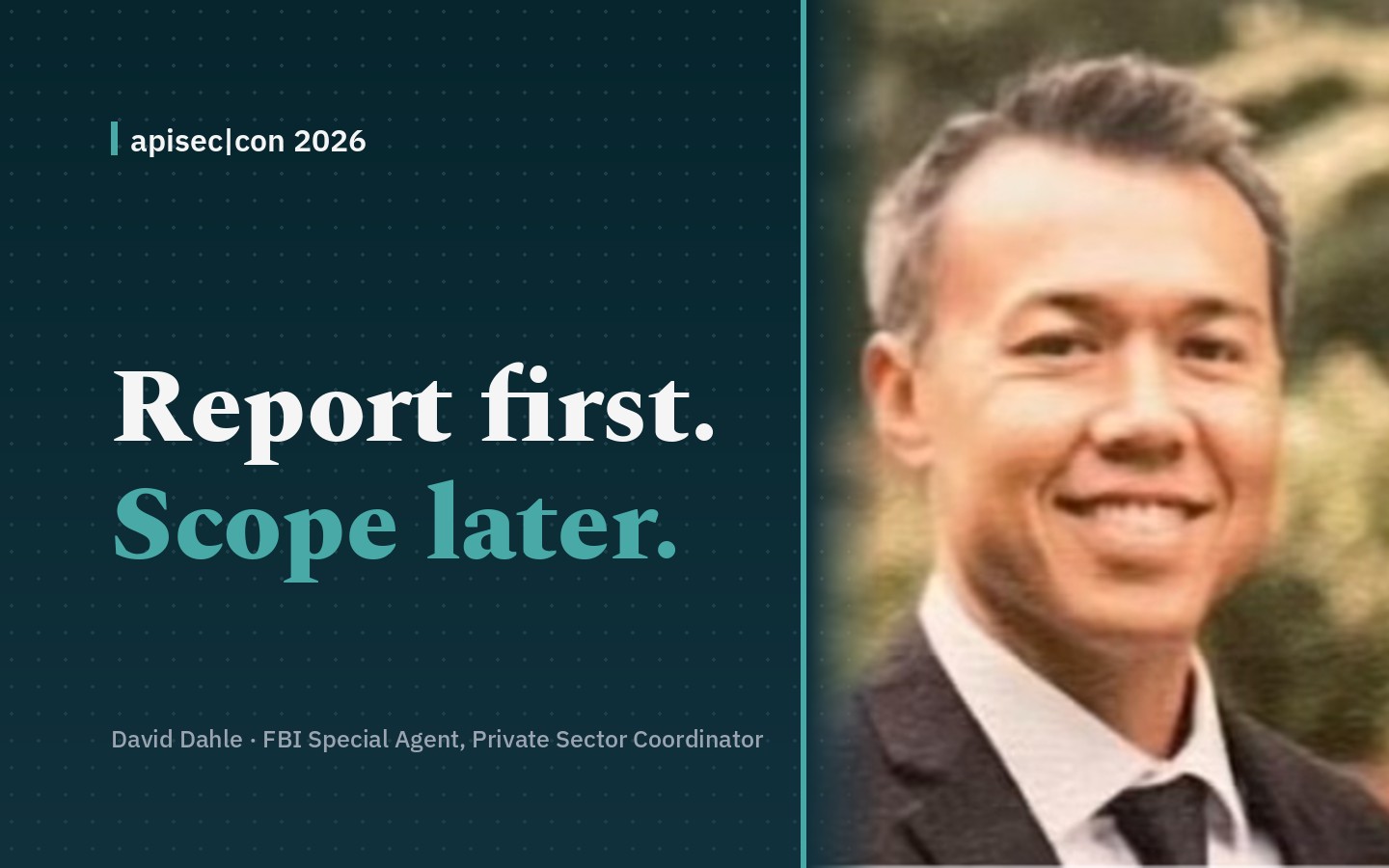
Most security leaders have a plan for containing an incident. Far fewer have decided, in advance, when to bring in law enforcement and who to call. In the middle of an incident, that question tends to get pushed back until the team knows more. That delay has a cost.
At apisec|con 2026, FBI Special Agent David Dahle, a private sector coordinator, walked through what happens when a company reports a cyber incident to the FBI, which threats he sees most, and what security teams can do before anything goes wrong. His session, "You Called the FBI. Now What?", was hosted by Christine Bevilacqua of apisec University.
Here are six lessons from the session that every security program can act on.
1. Report early, before you know the scope
In the Q&A, Christine asked when an organization should involve the FBI if it suspects an incident but hasn't confirmed its scope. David's answer was direct: as early as possible.
"the quicker you report it and the quicker we get involved, the more likely it's gonna save you money as a company, from loss amounts and mitigating the threats." (28:08)
He added that early reports have a much better chance of leading to a prosecution later, and that there's no harm in reporting early. Whoever you reach will connect you with the squad working that type of threat, which can guide you as your own investigation continues.
The lesson for leaders is about timing. Teams often wait until they can describe an incident fully before they call anyone outside the company. David's advice is to make the call first and let the picture fill in afterward.
2. AI-generated fakes are now too good to spot
David works on elder fraud and used to give audiences a list of red flags, such as typos, that suggested an email was fake. He has stopped:
"I don't even do that anymore, because the AI-generated content is so good that I don't think normal people can detect what's real versus fake anymore." (15:24)
He says he hears the same from CISOs and CIOs at many companies.
This changes what security awareness training can promise. If people can't reliably tell a real message from a convincing fake, defenses can't depend on someone noticing. Controls that hold up even when nobody spots the fake, such as phishing-resistant authentication and verifying payment requests through a second channel, carry more of the load.
Our view at apisec: the same models that write convincing fakes also make every attack attempt cheaper. Defenders need to find and close their own weaknesses before attackers do, rather than relying on people to catch what gets through.
3. Tricked into a payment? Call your bank first
If someone at your company, or in your family, is tricked into sending a wire or crypto payment, David laid out the order of operations:
"Well, call your bank first. Let them know, "Hey, try to claw back that payment or put a hold on it." Then report it to ic3.gov." (16:39)
A report to ic3.gov, the FBI's Internet Crime Complaint Center, starts what he calls the Financial Fraud Kill Chain: an alert to banks that a payment was involved in fraud, so they can try to recover it. In the Q&A he stressed speed. He said that a fraud-induced payment reported within 72 hours has a good chance of being at least partly returned, and that outside that window the chance is very small.
This belongs in your finance team's playbook as much as in the security team's. The people approving payments should know the two calls to make, and in what order, before they ever need them.
4. Business email compromise is still the way in
With so much attention on new threats, David's view of what he sees every day was a reality check:
"Business email compromises are still the biggest vector for threat agents to get inside your company." (13:11)
He listed data breaches, ransomware, intrusions and insider threats alongside it, and pointed to people inside the company as one of the biggest risks: clicking on things they shouldn't, being lazy about passwords, or taking data out of the organization without the right safeguards in place.
None of this is new, and that's the point. Most of what reaches the FBI starts with familiar weaknesses. New threats deserve attention, but not at the expense of closing the doors attackers already use.
5. Most attacks are stopped by simple fixes
David shared the FBI's current top 10 security recommendations and was candid that none of them are exotic. "Most of the time stopping bad actors comes down to very simple fixes," he said. The list:
- Adopt phishing-resistant authentication
- Implement a risk-based vulnerability management program
- Track and retire end-of-life technology on a defined schedule
- Manage third-party risks
- Protect and preserve security logs
- Maintain offline, immutable backups and test restoration
- Identify, inventory and protect internet-facing systems and services
- Strengthen email authentication and malicious content protections
- Reduce administrator privileges to only those who need it
- Exercise incident response plans with all stakeholders
On logs, he noted they matter for more than detection: they're essential if the FBI is ever going to identify and prosecute the attacker.
Our view at apisec: "identify, inventory and protect internet-facing systems" is the item that makes the rest possible. You can't manage vulnerabilities, retire old technology or protect what you haven't found. Knowing every application you have deployed, and what an attacker could actually use in it, comes first.
6. Put law enforcement in your incident response plan
The last recommendation on the list is the one David says he talks about with companies all the time:
"But you should have a local law enforcement point of contact on your incident plan, just in case there's an incident." (22:44)
That contact doesn't have to be the FBI; he noted other agencies can fill the role. If your company runs tabletop exercises, he said the FBI may be able to provide someone to simulate its response during a critical incident, given enough notice. He also pointed to InfraGard, a partnership between the FBI and members of the public that gives members access to threat reports and events after a light background check.
What this means for your program
- Decide when to call before you need to. Write the trigger for contacting law enforcement into your incident response plan, and make it early, not "once we know the scope."
- Name the contact. Add a local law enforcement point of contact to the plan and practice with it in your next tabletop exercise.
- Give finance a payment-fraud playbook. Bank first, then ic3.gov, as fast as possible.
- Stop relying on people to spot fakes. Prioritize phishing-resistant authentication and out-of-band verification for payment and access requests.
- Start with an inventory. Use the FBI's top 10 as a checklist, beginning with knowing every internet-facing system and application you run.
Closing
David's message was simple: report early, and get the basics right before something goes wrong. Neither depends on new technology. Both depend on deciding in advance.
Watch David's full session on the apisec University YouTube channel. To build the fundamentals behind several of these recommendations, take the free API Security Fundamentals and API Authentication courses at apisec University.
The views in this post are apisec's, and the session reflects the speaker's own views. Mention of apisec does not imply endorsement by the FBI or the US government.
FAQ
When should a company contact the FBI about a cyber incident?
As early as possible, according to FBI Special Agent David Dahle, even before the company knows the full scope. He says early reports have a better chance of leading to prosecution and of reducing losses, and that there's no harm in reporting early. The FBI can then connect you with the squad working that threat.
What should you do if your company is tricked into sending a payment?
David's advice is to call your bank first and ask it to stop or claw back the payment, then report it at ic3.gov. An IC3 report starts the Financial Fraud Kill Chain, which alerts banks so they can try to recover the money. He stresses that speed matters most.
What happens after you report a cyber incident to the FBI?
David explains that the report is routed to the most appropriate field office and squad, depending on where the victim, company or suspect is located. For major incidents, the FBI has a rapid response cyber action team, and trained ransomware negotiators can assist if a company requests it.
Should an incident response plan include law enforcement?
Yes. David recommends naming a local law enforcement point of contact, such as the FBI or another agency, in every incident response plan. Our apisec perspective: practice with that contact in tabletop exercises, so the call takes minutes, not hours, when a real incident happens.
The deploy gate is the last control point
The depth of a human. The coverage of a machine.
Start free and see a proven exploit against your own application, or get a walkthrough tailored to your stack.