SAST
Static analysis tells you if your code has bad patterns.
What's exploitable changes as fast as your application does. And your application is far more than code.
Every piece below moves independently, and each can be exploited, whether your team thinks about it that way or not.
AI-generated code, new microservices, new connections: they multiply that surface faster than any team can track by hand, and faster than a point-in-time review was ever built to catch. What worked two years ago wasn't built for this speed. Nothing was. Until now.
A living model of what your application actually is: code, APIs, the identity layer, and third-party connections. Then we run thousands of attacks against that model continuously, updating it in real time as your app changes, wired into your SDLC and CI/CD, on every release.
Not once a year. Not "mostly." If something's exploitable, you find out now, not after it's in production, and not after someone else finds it first.
Tools like Claude and OpenAI's models are changing how fast code gets written, and increasingly how it gets checked for surface-level flaws. That's real, and it isn't going away.
But generative AI is already being used to discover APIs and probe them for weaknesses, and it keeps getting better at it. When something's exploitable, AI doesn't just help attackers find it. It lets them exploit it at machine speed, continuously.
"Through 2029, over 50% of successful cybersecurity attacks against AI agents will exploit access control issues, using direct or indirect prompt injection as an attack vector."
Dionisio Zumerle and Jeremy D'Hoinne, "How to Secure Custom-Built AI Agents," Gartner, March 17, 2025.
Access control is not a property of your code. It's a property of your running application: who is calling, what token they carry, and what the business logic lets that token reach. A repo scan cannot answer that question.
AI made building faster. It made exploiting faster too. What it didn't do is make "is this exploitable?" any easier to answer. That's still our job.
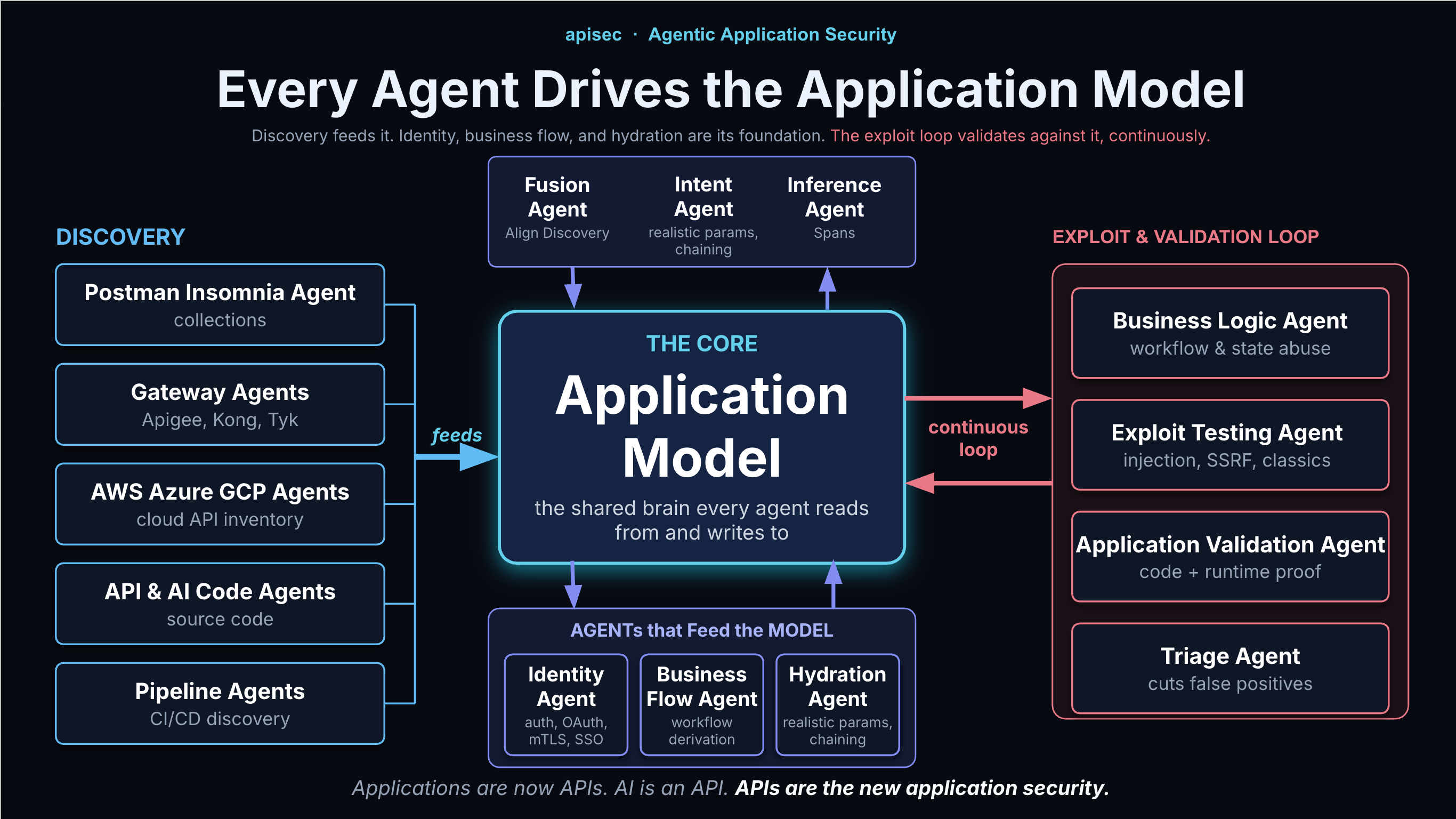
We build a living model of your application, because every application is different, and without that model you don't have anything. Without it, you have alerts. With it, you have proof.
Discovery agents feed the model. Identity, business flow, and hydration agents keep it accurate. The exploit and validation loop continuously runs against it and writes what it learns back in.
That write-back is the part nobody else does. A scanner reports and forgets. Our model gets smarter every cycle, because every attack result becomes part of what the next attack knows.
We fit right in.
Static analysis tells you if your code has bad patterns.
Dynamic testing tells you if a running app has common, generic vulnerabilities.
SCA tells you if your dependencies have known vulnerabilities.
All of these matter. None of them tells you whether your actual application, with its real APIs, real authentication, and real third-party connections, can be exploited right now.
apisec tests what your other tools can't see: the business logic, the access control, and the way your APIs talk to each other and to services outside your walls. The stuff that's unique to your environment and breaks in ways a generic scanner was never built to catch.
And it's not a one-time integration. We plug into your SDLC and CI/CD once, then run continuously, evolving with your stack instead of going stale like a point-in-time pen test does.
Other tools tell you what might be exploitable. We tell you exactly what is.