AI Agents Are Running Attacks Now. They're Not Inventing New Ones.
The FBI and Google say AI agents now run intrusions at machine speed. The way in is still exposed APIs and leaked keys. What's real and what to fix first.
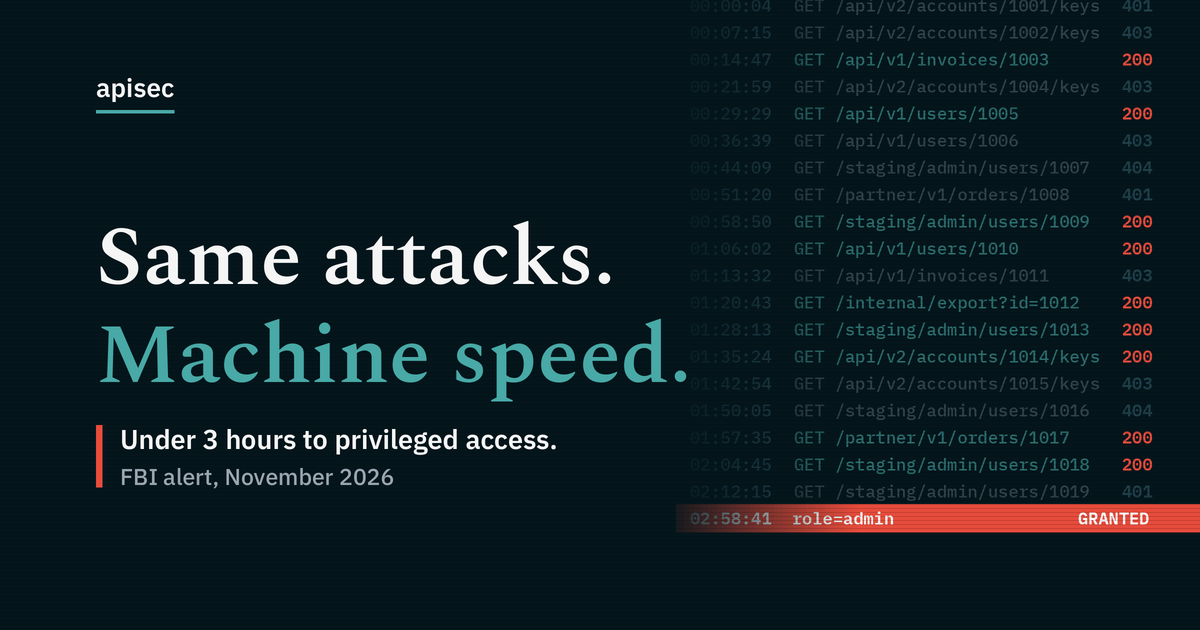
The short version: ARTEX is an open-source AI penetration testing framework that attackers have repurposed. The FBI says it has been used in real intrusions since at least August 2026, with some reaching privileged access in under 3 hours. Google reported this week that a separate framework turned security patches into working exploits with no human involved. The techniques are old: leaked credentials, exposed APIs, missing authorization. The speed is new.
Every security conversation I'm in right now ends up at the same question. Is the AI attack thing real, or is it marketing?
So I'm living inside two truths at once.
It's real. AND much of what you've read about it is overstated.
What is ARTEX, and what did Google and the FBI report?
ARTEX takes a goal written in plain language and hands it to AI agents that plan and run the attack steps. It was released as a legitimate testing tool in July 2026. The FBI's November 13 FLASH alert says threat actors have used it since at least August, across financial services, government, healthcare, energy, and more.
Three days later, Google's Threat Intelligence Group described something it says it had not observed before: a framework called exploit_agent that compares web application code before and after a security update, works out the flaw, writes an exploit, and runs it. No human in the loop.
That's the fear part. So here's what the same reports say when you keep reading.
Fear versus fact
Fear: AI is discovering attacks we've never seen.
Fact: Unit 42 analyzed real ARTEX intrusions and wrote, "AI-driven tooling is not inventing new attacks." It described cloud access gained "without exploiting a single software vulnerability." The way in was public password reset pages, exposed APIs, and stored credentials. The FBI's list reads the same: hardcoded passwords in JavaScript bundles, missing authentication on web APIs, IDOR, SQL injection, compromised vendor credentials. Google's report says the same thing in one line: "the mechanics of the intrusions remain the same."
Fear: These attacks are invisible.
Fact: Google says the frameworks "trade stealth for velocity." They're noisy. The catch is that noticing isn't the same as stopping. Barracuda found its intruder about 2 days after the attacker had finished.
Fear: Every patch is now an instant exploit.
Fact: Fully hands-off, Google found one exposed server doing this, aimed at popular web application software, with no victim count published. The human-assisted version is further along: Google cites a campaign that hit hundreds of organizations 4 days after two PaperCut flaws were disclosed, with exploits likely built using AI. And after two PHP patches in October, hundreds of claimed proofs of concept appeared that didn't work, likely AI-generated. So it's real, it's uneven, and a lot of it is noise.
Fear: There's nothing a normal team can do against a machine.
Fact: In one case Unit 42 observed, an agent validated more than 200 client secrets in about 3 minutes. That only works if 200 secrets are sitting where an agent can find them.
What changed, in Unit 42's words, is "the pace and the persistence." An agent doesn't get bored on your forgotten partner portal. It tries every endpoint in the OpenAPI spec you left public. Then it tries them again.
How do you defend against AI-driven attacks?
The FBI and Unit 42 guidance overlaps almost completely, which is reassuring. In priority order:
- Inventory what's internet-facing, especially the unglamorous stuff. The FBI says ARTEX does best against partner and supplier portals, mobile backends, and legacy services.
- Require authentication on every write endpoint, including dev and staging.
- Enforce authorization on the server for every object. Alert on sequential lookups and unusually high record counts in a session.
- Take OpenAPI specs, source maps, and config files with tokens off public hosts. Agents use them as a map.
- Replace long-lived keys with short-lived, role-based access. Scan repos, pipelines, and configs for secrets and rotate what you find.
- Rate-limit self-service flows like password reset, registration, and verification codes.
- Put preventive controls ahead of detection. If the attacker needs 3 hours and your analyst needs 2 days, the alert is a history lesson.
- Start your remediation clock when the patch ships. Not when the scanner flags it.
None of that is new advice. That's sort of the point.
Frequently asked questions
What is ARTEX?
An open-source, LLM-driven penetration testing framework that turns natural-language goals into attack steps run by AI agents. Its developer removed the original repository in October 2026, but forks remain available.
Can AI turn a security patch into an exploit?
Yes. Google's Threat Intelligence Group reported one operator doing so without human involvement. The scale and success rate have not been published.
Do AI attacks use new techniques?
Not according to the FBI, Google, or Unit 42. They automate known weaknesses such as exposed credentials, unauthenticated APIs, and broken authorization.
The backlog you've been meaning to get to (the unauthenticated staging API, the key from 2024, the endpoint that trusts the ID in the URL) used to be protected by the fact that attackers are busy people.
They're not busy anymore.
This is the conversation Corey and I keep having in person. We run a 2-hour workshop for dev and security teams, all over North America (and virtually when that's easier), on what the AI attack surface actually looks like and what it means at your organization specifically. Not a generic threat briefing. Your APIs, your agents, your backlog.
It's free for teams. If the list above felt uncomfortably familiar, that's where I'd start.
The deploy gate is the last control point
The depth of a human. The coverage of a machine.
Start free and see a proven exploit against your own application, or get a walkthrough tailored to your stack.