Burp vs ZAP: Which Finds More API Bugs?
Compare Burp Suite and OWASP ZAP for API security testing. In-depth analysis of features, pricing, automation, and OWASP Top 10 coverage — updated for 2026.

Cyberattacks have been on the rise, with over a 600% increase in attacks in the first quarter of 2022, and new vulnerabilities continue to be discovered every day.
It's no wonder that 62% of organisations have slowed their production of new applications due to the uncertainty surrounding their API security.
That’s why API security testing is a necessity for ensuring secure web applications. And two tools that come in handy for this are Burp Suite and OWASP ZAP.
Why API Testing Tools Matter: Real Incidents & Statistics
API breaches have become one of the most common attack vectors:
- 74% of APIs contain at least one OWASP API Top 10 issue (Salt Security).
- 94% of organisations faced API security incidents (Postman).
- Optus (2022) exposed customer records due to unauthenticated API access.
- T-Mobile (2023) leaked data of 37 million users through an API exploit.
- USPS (2018) exposed information of 60 million accounts via a broken API authentication layer.
- Venmo publicly exposed millions of transactions due to an open API endpoint.
These patterns align closely with categories such as BOLA, Excessive Data Exposure, and improper asset management described in the OWASP API Top 10.
Both of these tools are incredibly powerful and can be used to find vulnerabilities in APIs. However, they each have their own strengths and weaknesses.
In this article, we will look at the core features of these two API security testing tools and compare them side-by-side.
What Is Burp Suite?
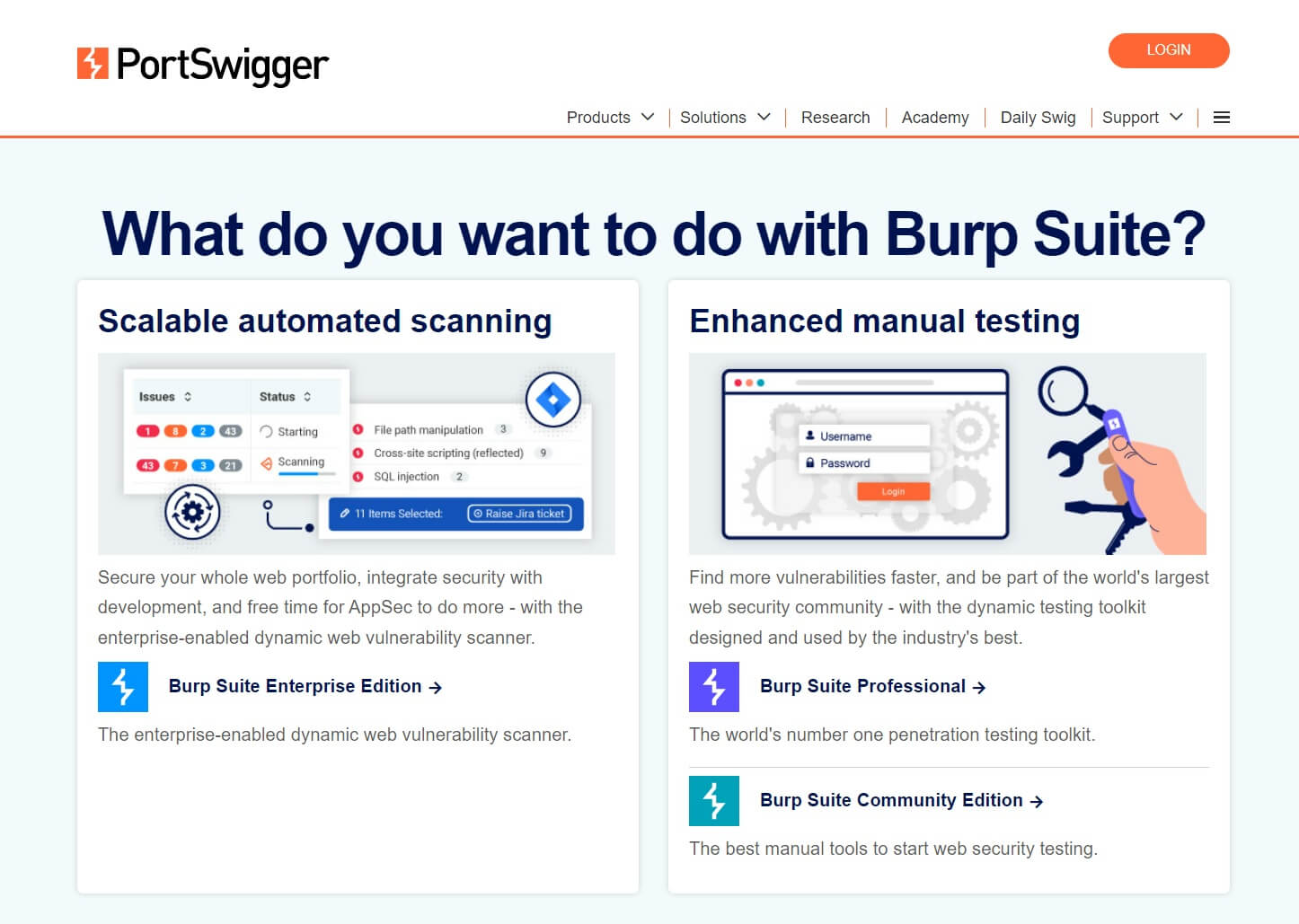
Developed by Portswigger Inc., Burp Suite is a powerful and versatile tool for performing security testing of web applications.
The software consists of a large number of tools interconnected by a multitude of interfaces aimed at facilitating and accelerating the attack process. Plus, you can increase Burp's capabilities with add-ons, referred to as BApps.
From initial mapping and analysis to identifying vulnerabilities in your application's codebase, the integrated platform supports the entire testing process.
Burp Suite is a great place to start if you're new to API security testing. It's easy to use and contains all the tools you need to get started.
What Does Burp Suite Offer for API Testing?
Burp Suite is commonly viewed as a web-app testing tool, but it also supports several API-specific testing workflows:
- API Request Interception: Captures REST, JSON, XML, and form-based API calls in real time.
- GraphQL Support: Through extensions such as GraphQL Raider, enabling introspection queries.
- Token & Auth Handling: Requires manual macros for OAuth, cookies, JWT renewal, and API keys.
- Fuzzing & Replay: Repeater and Intruder allow brute-force, parameter tampering, and replay attacks.
- Scripting: BApps let testers add custom logic for APIs.
- CI/CD Automation: Only available in Burp Suite Enterprise; limited in Pro/Community editions.
These capabilities make Burp useful for manual API exploitation, but it struggles with logic flaws such as those explained in business logic vulnerabilities.
What Is OWASP Zap?
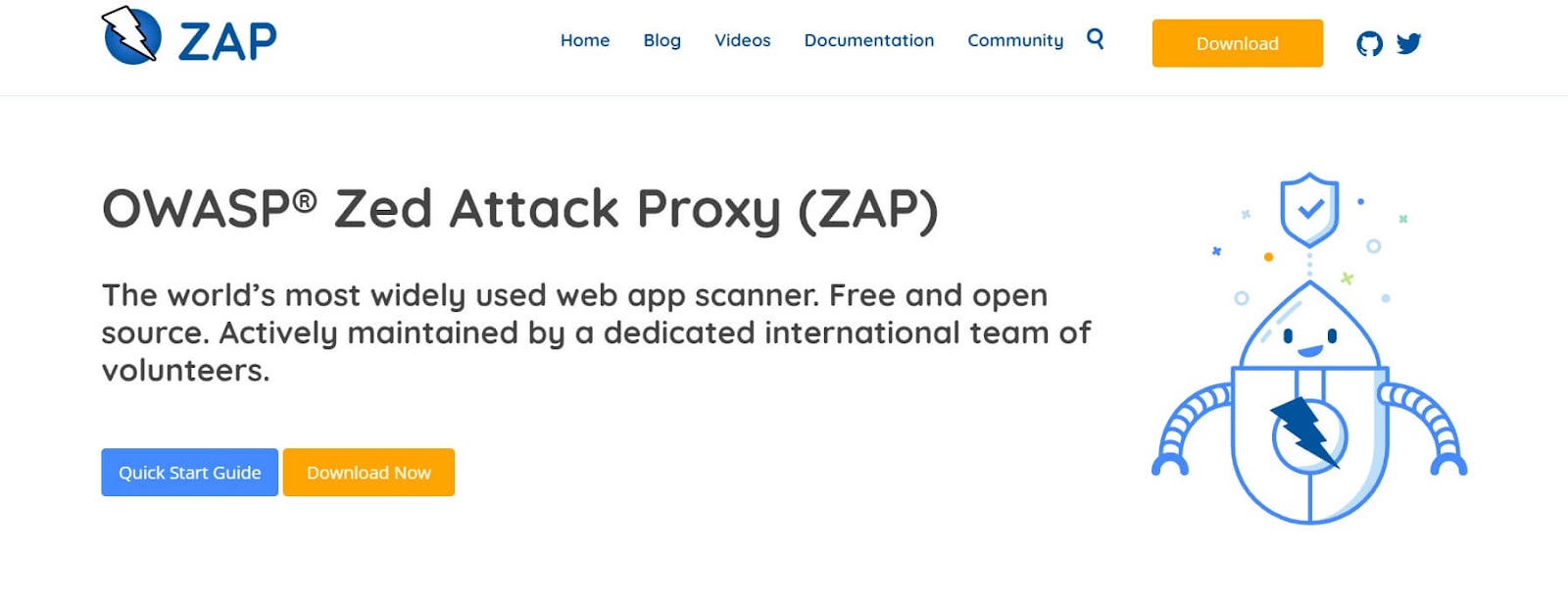
OWASP ZAP is a free and open-source security tool that helps you automatically find and fix vulnerabilities in your APIs.
ZAP can be used to scan for common web application vulnerabilities, such as SQL injection and cross-site scripting, and also provides an interface for custom security testing.
From beginners to professionals wanting more control over their projects, it's an easy and flexible solution that anyone can use. Plus, it can be seamlessly integrated into your existing workflows.
What Does OWASP ZAP Offer for API Testing?
OWASP ZAP provides structured capabilities for APIs beyond traditional web scanning:
- OpenAPI/Swagger Imports: Automatically discovers endpoints from API specifications.
- Active & Passive API Scanning: Detects common weaknesses in REST services.
- Scriptable Authentication: Supports session tokens, JWTs, and access tokens using JS/Groovy scripts.
- API Fuzzing: Customizable scan rules allow flexible payload testing.
- GraphQL Support: Available through add-ons.
- CI/CD Compatibility: ZAP’s YAML Automation Framework integrates with GitHub Actions, Jenkins, and Docker.
These capabilities help uncover surface-level flaws, but not deeper authorisation gaps highlighted in the OWASP API Top Ten.
Burp Suite vs. OWASP ZAP: Comparing Core Features
As two of the most popular API security testing tools, Burp Suite and OWASP ZAP both have a lot to offer users. But how do they compare when it comes to core features?
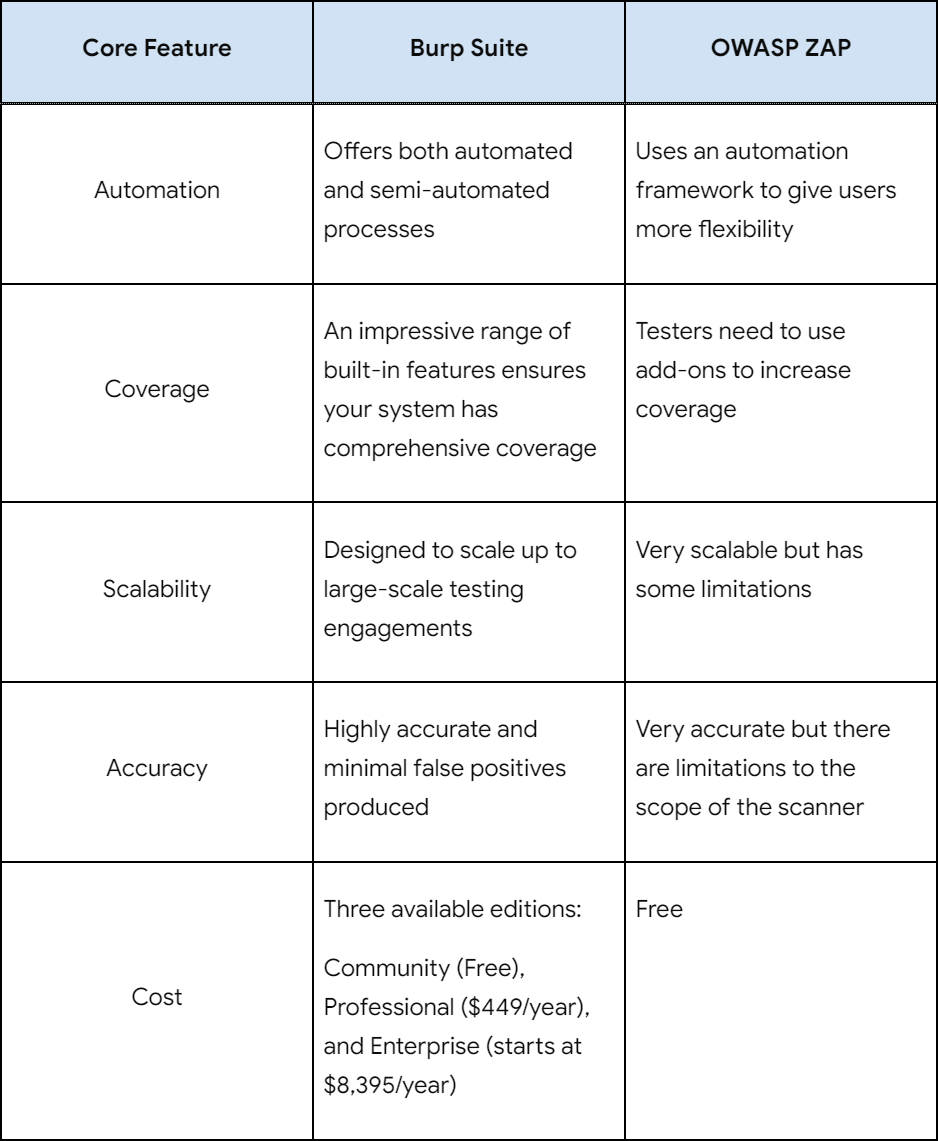
Here's a quick cheat sheet that shows exactly how these two tools compare:
Automation
Burp Suite and OWASP ZAP are both powerful tools for automating web application security testing. However, the slight edge goes to ZAP due to its automation framework.
In one of its more recent updates, ZAP has been revised to use a new automation framework, where ZAP can be controlled with one YAML file.
This gives you more flexibility without being tied down to any particular container technology, such as Kubernetes or OpenShift. It's also easy to automate the ZAP security scans, so you can integrate them directly into your CI/CD pipelines.
To be fair, Burp Suite offers both automated and semi-automated processes that work in tandem with manual tooling, but it's not as comprehensive as ZAP.
Coverage
In terms of coverage, both Burp Suite and OWASP ZAP are very effective at finding common web application vulnerabilities.
However, Burp Suite has greater flexibility and a range of features, meaning it's more likely to find more types of vulnerabilities in a given application.
OWASP ZAP also offers comprehensive coverage, but pen-testers will need to add some add-ons to ZAP's scanning engine to improve its ability to detect the OWASP vulnerabilities.
Scalability
When it comes to scalability, these two tools are pretty neck and neck.
Burp Suite Enterprise is designed to scale up to large-scale testing engagements. It can be used to test hundreds of applications concurrently and can be deployed in a distributed fashion across multiple machines.
However, the upgrade to Burp Suite's Enterprise Edition comes with a higher price tag.
OWASP ZAP is also scalable but is not quite as flexible as Burp Suite in terms of concurrent testing and distributed deployment. However, its automation, add-ons, and constant updates make it a competitive alternative.
Accuracy
One of the most important aspects of a security tool is its accuracy, and both Burp Suite and OWASP ZAP have been extremely accurate in their findings.
There are, however, a few key factors that we want to point out. The first is that OWASP ZAP is great for finding some common vulnerabilities, but it has some limitations regarding the scope of its scans.
While it's accurate for what it scans, it's still missing potential vulnerabilities.
Additionally, some users find that Burp Suite's automated scanner produces fewer false positives than OWASP ZAP's.
Costs
This is where OWASP ZAP gains a clear advantage over Burp Suite because ZAP is a free tool, period.
Burp Suite does offer a free edition of its tool (Community), but it's very limited in features and capabilities. However, the other editions, Professional ($449/year) and Enterprise (starts at $8,395/year), unlock even more features.
Overall, OWASP ZAP is a good choice for organizations with limited budgets.
API Testing Capabilities Compared
Burp Suite Strengths (API-Specific):
- Precise manipulation of API headers, tokens, and params
- Better for debugging complex REST calls
- Useful for manual workflow break attempts
- Ideal for identifying parameter-based flaws
OWASP ZAP Strengths (API-Specific):
- Strong automated scanning for known OWASP-style issues
- Best for teams relying on CI/CD automation
- Faster baseline coverage via OpenAPI imports
Where Both Tools Fall Short:
Neither reliably detects:
- Broken Object Level Authorisation (BOLA)
- Multi-step workflow bypasses
- Multi-tenant or role escalation
- Shadow API discovery issues
These flaws drove major breaches, such as:
- T-Mobile 2023 unauthorised API data access (Reuters)
- USPS 2018 missing API auth checks (KrebsOnSecurity)
Shadow API issues are explained deeper in the guide on API discovery risks.
Which Should You Choose?
Choose Burp Suite if…
- Your goal is manual API testing.
- You want a polished proxy/repeater workflow.w
- API has complex parameter manipulation needs
- You’re performing a short-term pente.st
Choose OWASP ZAP if…
- You want automated scans with minimal setup.
- You’re integrating security into the CI/CD pipeline.s
- You prefer open-source too.ls
You need to import API specifications for quick coverage.
Choose an Automated API Security Platform if…
Burp and ZAP do not reliably detect logic flaws, broken authorisation pathways, or workflow abuses that cause real incidents.
For example:
- Optus (2022) unauthenticated API route exposed customer data (The Guardian)
- Venmo public API exposing millions of transactions (Wired)
You need an automated API security platform (example category explained in best API security testing tools) if:
- You operate large microservice API estates
- You require multi-role or multi-tenant testing.
- You need continuous regression on every CI/CD commit.t
- You must detect BOLA, EDE, workflow abuse, and shadow APIs
Alternatives to Burp Suite and ZAP for the Best API Security Testing Solution
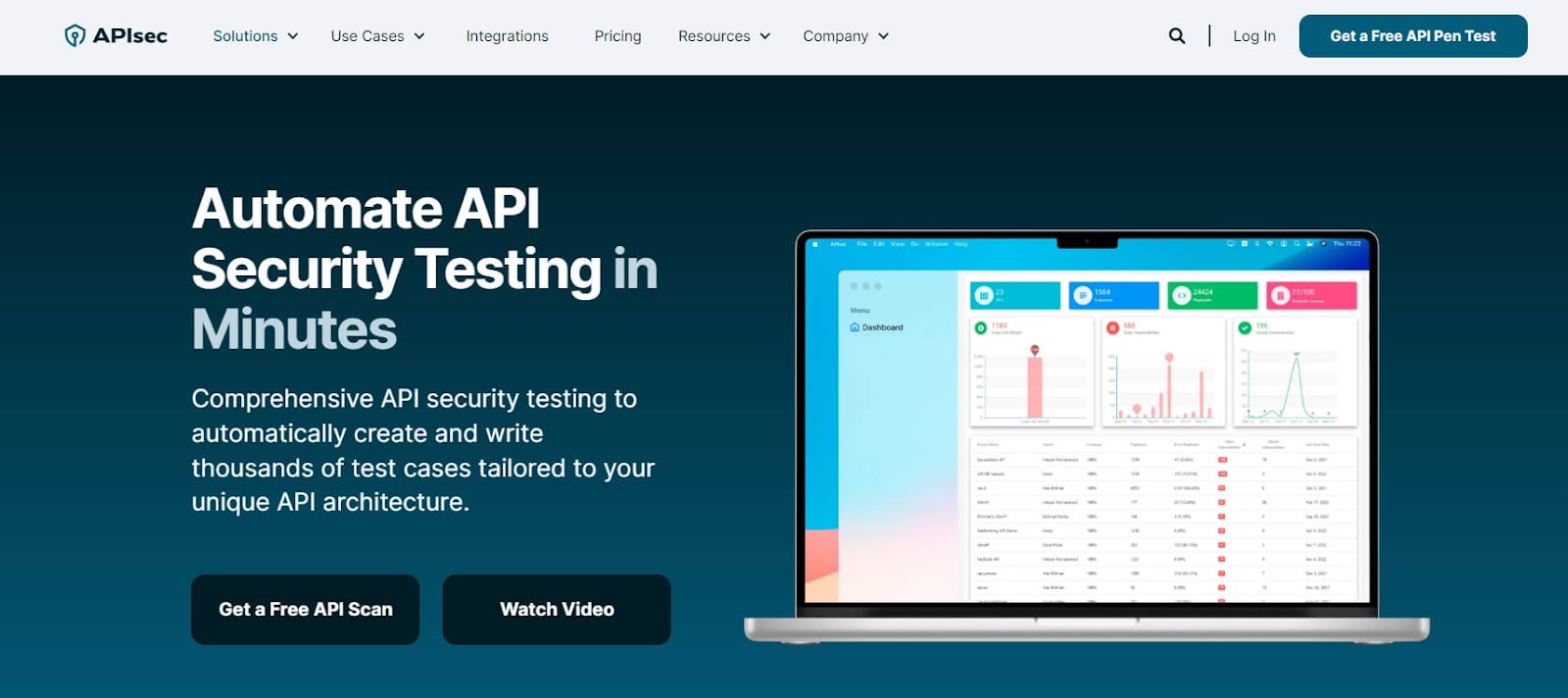
There are some vulnerabilities that even these tools (and their add-ons) still can't uncover, like those pesky business logic flaws.
This isn't a problem for APIsec. In fact, our AI-powered technology can automatically uncover business logic flaws that other solutions miss.
How do we do this? By deeply analyzing every corner of your API using:
- API Analyzer: To ensure we're testing every surface of your API, we learn your API's unique architecture—breaking down to every endpoint, call, and input parameter so that the engine knows how best to attack.
- API Attacker: Instead of focusing on the most common attacks, we create thousands of custom attack scenarios unique to your API, giving them unprecedented coverage.
- API Scanner: This engine searches for anything unexpected in the tests generated by API Attacker and generates a report, making it easy to identify any potential problems.
See how we do it:
In addition, APIsec is more affordable than Burp Suite. With APIsec, you can get started with a free trial, so you can see for yourself how effective it is before committing to a paid plan.
If you're serious about finding a powerful and comprehensive solution for API security testing, then look no further than APIsec.
Get in contact with our team and start securing every corner of your API.
FAQs
1. What are the disadvantages of using Burp Suite for API security testing?
Burp Suite handles web apps well but struggles with large or complex APIs. It needs manual setup for tokens, can’t detect shadow APIs, and lacks automation for business logic testing at scale.
2. What are the limitations of OWASP ZAP for API scanning?
OWASP ZAP offers basic web scanning but isn’t built for REST or GraphQL APIs. It faces issues with tokens, JSON payloads, and multi-step authentication, limiting deep, automated API vulnerability coverage.
3. Is Burp Suite a DAST tool?
Yes, Burp Suite is a DAST tool that scans live applications for vulnerabilities. It’s mainly suited for web interfaces rather than full, automated API testing pipelines.
4. Is Burp Suite good for beginners in API testing?
It’s good for learning manual testing and HTTP basics, but it can be complex to configure for APIs. Beginners often prefer easier, automated tools for faster results.
5. Does Burp Suite use AI for security testing?
Yes, Burp Suite now includes Burp AI to explain results and reduce false positives. These assistive features help testers but don’t fully automate API security analysis.
6. Which tool is better for modern APIs, Burp or ZAP?
Burp is better for manual analysis; ZAP is better for automated scanning. Neither helps with the logic flaws outlined in business logic vulnerabilities.
7. How do Burp and ZAP handle CI/CD pipelines?
ZAP integrates natively through GitHub Actions, Jenkins, and Docker. Burp requires the Enterprise edition for any pipeline automation.
8. Which tool is easier for beginners?
ZAP is generally easier because of its templates and automation framework. Burp requires more setup, especially for API authentication.
9. When is a dedicated API security platform necessary?
When your API surface is large, updated frequently, or requires multi-step, multi-role logic testing. A comparison of such platforms is available in the blog on API security testing tools.
10. Is Burp Suite good for API security testing?
Burp Suite API testing offers solid manual testing capabilities, but requires significant configuration and expertise to cover API-specific vulnerabilities comprehensively.
11. What are OWASP ZAP's API limitations?
While OWASP ZAP is free and open-source, it struggles with business logic flaws like BOLA and requires manual setup for thorough API endpoint coverage.
The deploy gate is the last control point
The depth of a human. The coverage of a machine.
Start free and see a proven exploit against your own application, or get a walkthrough tailored to your stack.